How Do You Keep Users Who Want to Leave?
Retain users by understanding what they want and when they want it. No dark patterns.
Impact
-19%
Plan Cancellations
-40%
Coaching Cancellations
-30%
Trial cancellations
+120%
Undo downgrade
Context & Problem
vidiq was growing. More plans, cheaper price points, more price-conscious users. Cancellations were climbing with it.
The existing downgrade flow was bare: a survey, then gone. No alternatives. No attempt to understand if the user was genuinely done or just in two minds.
The goal was simple: capture more users in the downgrade flow. Not through tricks. Not through hidden buttons or guilt trips. Through genuinely useful options at the right moment.
I owned the entire downgrade and cancellation experience across all three plans (Boost, Coaching, Max). Not as a single project, but as a system I kept building and iterating on over two years. Every test shipped to 100%. Every one stat-sig positive.
My Role & Approach
I designed, spec’d, and coded these flows alongside one engineer. Each test built on the previous one’s learnings. The thinking:
If your product is good, remind them. Users canceling aren’t always unhappy. Some forgot what they’re getting. Some hit a rough month. Some just need a cheaper option.
Cascade, don’t cliff. Instead of cancel-or-stay, give users a staircase down. A $49 user doesn’t have to go to zero. Maybe $19 works. Maybe $5. A paying user who downgrades is infinitely easier to re-upgrade than a churned user to re-acquire.
No deceptive patterns. Every step has a clear continue-to-cancel path. Dismiss once, we don’t show it again.
Process & Decisions
The downgrade flow: four steps
Step 1: Highlight value. Users joined for growth. Show them their growth.
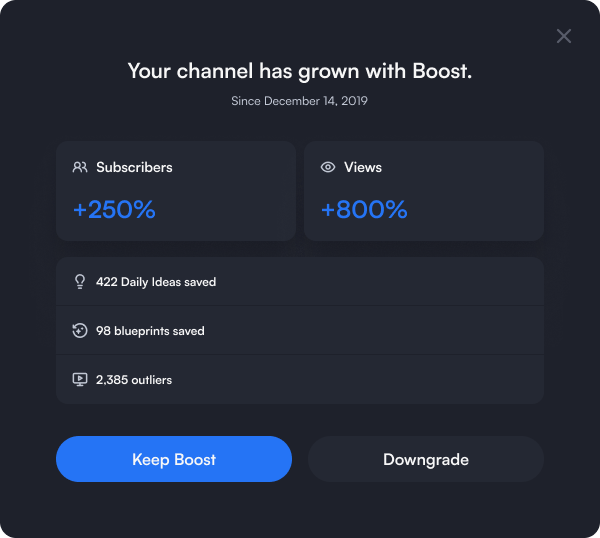
Subscribers up 250%, views up 800%. Are you sure?
Pull their actual channel metrics since subscribing. Subscriber growth, view growth, feature usage counts. Not generic copy. Their numbers. Real data, real loss aversion.
Step 2: Coupon logic. Our cancellation survey data consistently showed the top reason users left: too expensive. The coupon logic was the direct answer. Two paths based on what we know about the user.
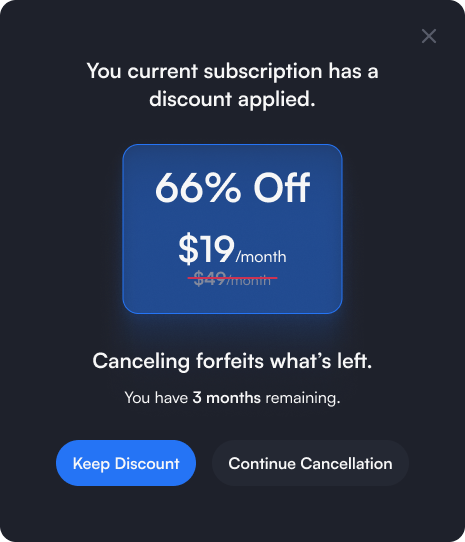
Already discounted? Remind them what they'd lose.
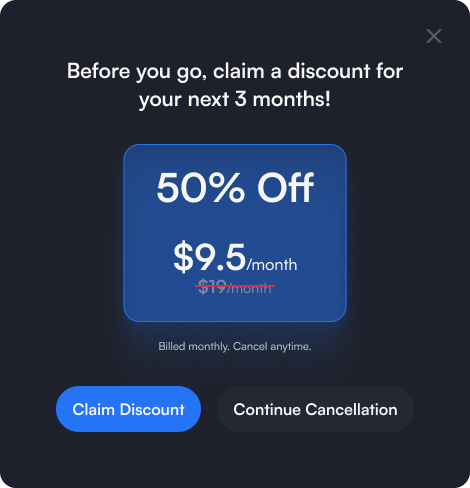
Full price? Offer a discount to stay.
Users with existing multi-month coupons get reminded: cancel now, lose this discount forever. Next time you’re paying full price. Users on full price get a discount offer. Standard retention move, but combined with the value reminder above, more effective. They just saw their growth. Now a cheaper way to keep it going.
Step 3: Downgrade cascade. The move most companies skip entirely.
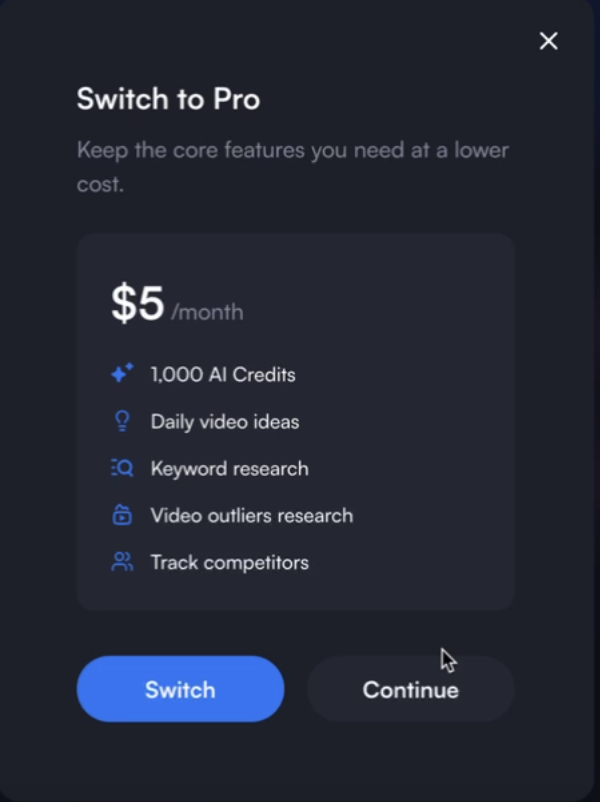
A $5 plan that can't be purchased directly. Only available through the downgrade flow.
Coaching and Max users get offered a downgrade to Boost. Boost users get offered a “sleeper plan,” a $5/month tier that doesn’t exist on the pricing page. Less than a coffee. It keeps them as a paying member while they take a break or just want something dirt cheap.
Why: upgrading a paying subscriber is a fundamentally different motion than re-acquiring a cancelled one. Keep them on the staircase, even at the bottom step.
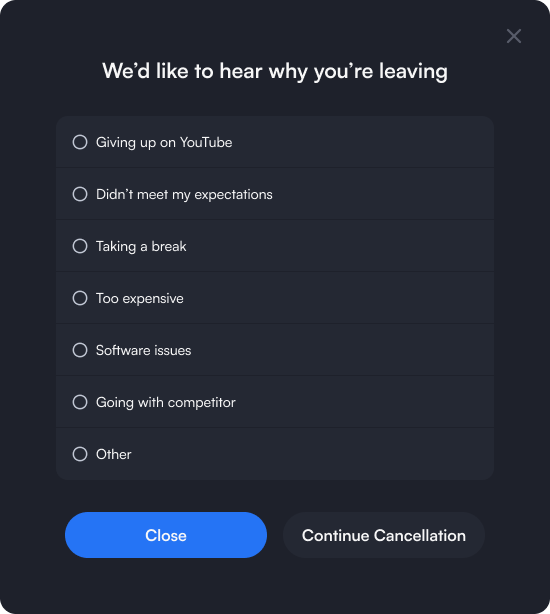
Step 4: Survey and cancel. If none of that worked, clean exit. Tell us why. Done.
After cancellation: the window nobody uses
When a user cancels mid-cycle, they still have days or weeks left on their subscription. Most companies ignore that window entirely.
But if a user comes back to the product after scheduling their cancellation, that’s a signal. They’re still finding value. Today is a new day, maybe their reasons for canceling have shifted. Give them a reason to undo it.
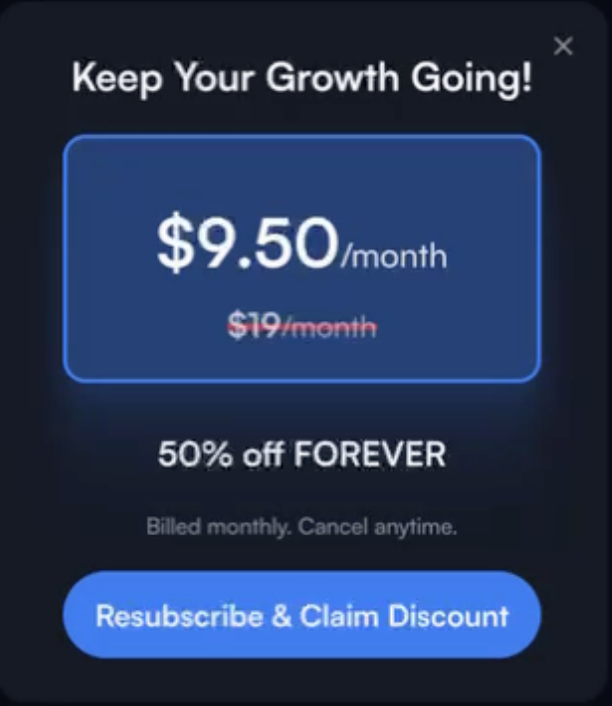
Dashboard card shown 12 hours after scheduling cancellation.
A card appears on the dashboard 12 hours after they schedule cancellation. Not immediately. Give them space. Personalized discount to undo it.
The capstone: Max plan
Max launched as a new $49/month tier. Instead of building its downgrade flow from scratch, I applied everything above. All four steps, all the learnings from Coaching and Boost, plus the resubscribe card.
Result: -19% reduction in Max downgrades. The system transferred to a brand new plan with zero iteration needed.
Outcome & Impact
Every test across every plan reached stat-sig and shipped to 100%:
Highlight paid feature retention: -4.3% cancellations overall, -30% trial cancellations. Loss aversion works strongest on newer users.
Remind or offer coupon: -9% cancellations (macro improvement). Coupon reminders were the insight. Users don’t want to lose something they already have.
Coaching downgrade flow: -40% coaching cancellations. Coupons, plan switching, and reminders all contributed.
Resubscribe dashboard card: +120% undone downgrades (+211% in core markets).
New Max downgrade flow: -19% downgrades. All learnings applied, worked first try.
100% hit rate across all downgrade experiments.
Lessons Learned
Systems beat one-offs. Any single test here is a modest win. Stacked together, they compound into a retention machine.
Cascade beats cliff. A user going from $49 to $5 is a loss. A user going from $49 to $0 is a bigger one.
The cancel button isn’t the end. Between scheduling and cycle end, users are still paying, still logging in. That window is real estate most PMs ignore.
Learnings transfer. The Max flow worked first try because it was built on a proven system.